
What Is a No-Code Token Launcher?
Launching a blockchain token traditionally requires more than choosing a name and clicking a button. Developers may need to write or customize Solidity smart contracts, configure token parameters, connect a Web3 wallet, select a blockchain network, pay gas fees, deploy the contract, verify the source code, and manage the deployed contract afterward. For someone without smart contract development experience, that process can be difficult to navigate.
A no-code token launcher simplifies this workflow by providing an interface where users can configure and deploy blockchain contracts without writing the smart contract themselves. Instead of manually preparing Solidity code and deployment scripts, users typically provide information such as the token name, symbol, supply, and other supported parameters through a graphical interface. A no-code token creator takes this further by letting users create and configure tokens without directly writing code. The basic idea is: Configure, connect a wallet, select a network, deploy, verify, and manage.
The exact features, supported networks, token standards, pricing, and management tools vary between platforms. This article compares several no-code token launchers based on ERC-20 and ERC-721 support, Base deployment, testnets, service fees, contract ownership, verification, open-source infrastructure, and post-deployment tools, based on the platform research collected for this article. Features and fees can change over time, so verify current details before deploying.
How Token Launchers Work
Although interfaces differ between platforms, the general workflow follows a similar sequence. First, the user configures the token — for an ERC-20 token this typically means the name, symbol, total supply, decimals, and any other supported parameters, while an ERC-721 contract involves NFT-related settings instead. Next, the user connects a compatible Web3 wallet, which authorizes the deployment transaction and pays the network cost. The user then selects a blockchain network to deploy to; some platforms support multiple Ethereum-compatible networks, while others focus on specific networks, and testnet availability can differ between them. Once configuration is complete, the user submits the deployment transaction and approves it in their wallet. After deployment, contract verification can make the source code available through supported blockchain explorers, making it easier to inspect the deployed contract. Finally, deployment isn't necessarily the end of the workflow — some platforms provide dashboards or other post-deployment tools for accessing contract information, deployment history, network details, and other features. Some token launchers concentrate on basic deployment, while others provide advanced token controls, multiple standards, multi-chain deployment, or richer contract management.
What to Look for in a Token Launcher
Choosing a token deployment platform involves more than comparing a single price. ERC-20 is a widely used Ethereum token standard for fungible tokens, where each unit is interchangeable with another unit of the same token; a no-code ERC-20 token creator simplifies configuring and deploying that kind of contract, so check which parameters can be customized and which network the resulting contract deploys to. ERC-721 is commonly used for NFTs and other unique on-chain assets, and because it serves a different purpose than fungible tokens, not every launcher supports both standards — if your project involves NFTs, confirm ERC-721 support specifically rather than assuming an ERC-20 platform also handles it.
Blockchain support matters too: Ethereum-compatible networks such as Base can offer an alternative environment for deploying smart contracts, but support varies between launchers, so confirm whether a platform supports Base mainnet and, where relevant, Base testnet. A testnet provides an environment to experiment with deployment before using real funds on mainnet — useful for learning the workflow, testing contract behavior, checking configuration, experimenting with wallets, and understanding transactions before committing to mainnet.
Pricing models also differ: some platforms charge a fixed service fee, others display pricing at checkout or combine platform charges with blockchain gas costs, so a useful comparison should separate the platform's service fee from the blockchain's gas fee. Contract ownership is another key question — who owns the deployed contract, which wallet controls it, whether ownership can be transferred, what administrative functions exist, and whether the platform retains any control. A no-code interface does not automatically mean the platform owns the resulting token contract. Contract verification makes the deployed source code available through supported blockchain explorers so users and developers can compare the published source with the deployed bytecode, and open-source infrastructure lets technically capable users inspect the underlying implementation directly — closed-source platforms can still offer useful interfaces and managed infrastructure, but the level of public visibility differs. Finally, consider post-deployment tools: dashboards that surface the contract address, deployment status, network information, verification status, token information, and deployment history make the process easier to manage after the transaction confirms.
No-Code Token Launcher Comparison
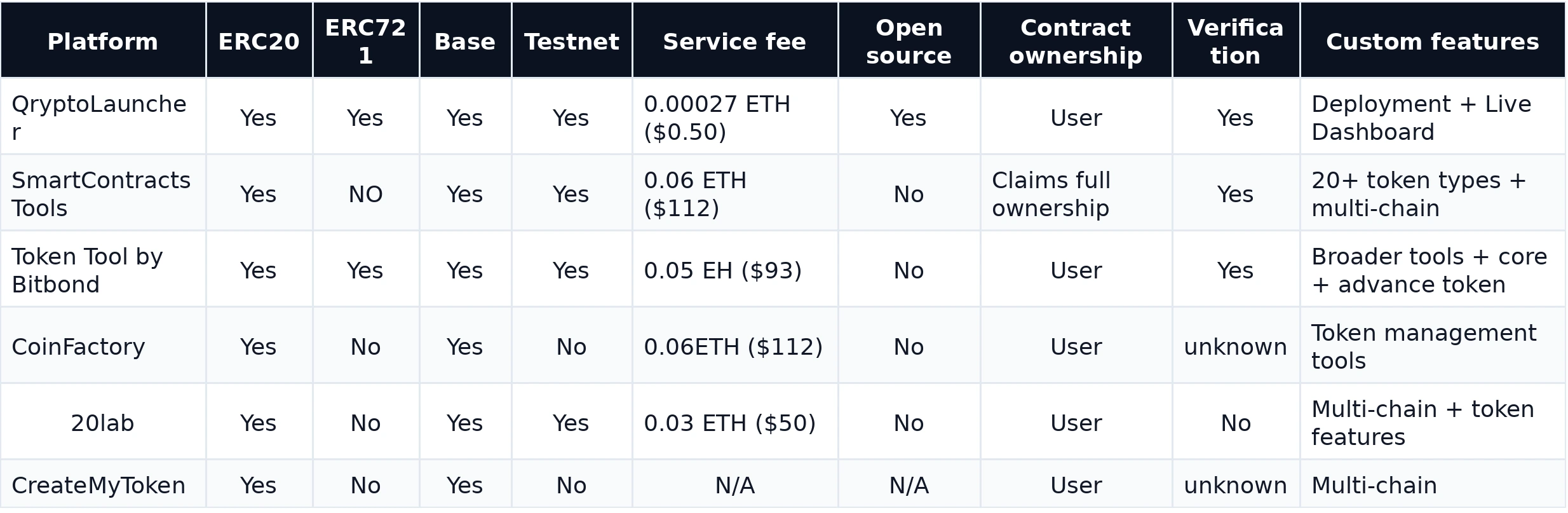
Based on the research collected for this article, QryptoLauncher supports both ERC-20 and ERC-721, deploys to Base, offers testnet deployment, lists a service fee of approximately 0.00027 ETH (around $0.50), is open source, keeps contracts user-owned, and supports verification. SmartContracts Tools supports ERC-20 but not ERC-721, deploys to Base with testnet support, lists a fee of approximately 0.06 ETH (around $112), is not open source, claims full ownership of deployed contracts rather than leaving them user-owned, and supports verification. Token Tool by Bitbond supports both ERC-20 and ERC-721, deploys to Base with testnet support, lists a fee of approximately 0.05 ETH (around $93), is not open source, keeps contracts user-owned, and supports verification. CoinFactory supports ERC-20 but not ERC-721, deploys to Base without testnet support, lists a fee of approximately 0.06 ETH (around $112), is not open source, keeps contracts user-owned, with an unknown verification status. 20lab supports ERC-20 but not ERC-721, deploys to Base with testnet support, lists a fee of approximately 0.03 ETH (around $50), is not open source, keeps contracts user-owned, and does not offer verification. CreateMyToken supports ERC-20 but not ERC-721, deploys to Base without testnet support, does not list a fee, does not list open-source status, keeps contracts user-owned, with an unknown verification status. These fees are research-date figures and should not be treated as permanent prices — always verify current numbers before deploying.
This comparison should not be read as a universal winner ranking. Token launchers use different pricing models and provide different combinations of features — some platforms focus on advanced token controls or broader functionality, while QryptoLauncher currently focuses on ERC-20 and ERC-721 deployment on Base with testnet support, contract verification, open-source contracts, user ownership, and a live deployment dashboard.
QryptoLauncher: A No-Code ERC-20 and ERC-721 Deployment Platform
QryptoLauncher is a no-code deployment platform focused on making ERC-20 and ERC-721 smart contract deployment accessible through a guided interface. Its current feature set includes ERC-20 token deployment, ERC-721 NFT deployment, Base support, testnet deployment, contract verification, open-source contracts, user-owned deployed contracts, and a deployment dashboard with live deployment information. QryptoLauncher focuses on making ERC-20 and ERC-721 deployment accessible through a simple no-code workflow while keeping deployed contracts transparent and under the user's control — a different positioning than claiming to be universally better than every alternative. The relevant question for users is whether this current feature set matches their requirements.
How to Create an ERC-20 Token Without Coding
Creating an ERC-20 token without directly writing Solidity generally involves configuring the token through a no-code deployment interface. The exact fields depend on the platform, but the process commonly follows the same shape: connect a compatible Web3 wallet to authorize the transaction and pay network costs, then select the ERC-20 deployment workflow — ERC-20 is designed for fungible tokens, so it's commonly used for project tokens, utility tokens, and other interchangeable assets. Configure the token details, which can include name, symbol, total supply, decimals, and other supported parameters; these become part of the deployed contract, so review them carefully since changing behavior after deployment usually isn't possible unless the contract was specifically designed to allow it. Choose a network — a supported testnet is useful while you're still learning the process, and the appropriate mainnet once the project is ready to go live. Submit the deployment transaction and approve it in your wallet; once confirmed, the contract receives its blockchain address. Where supported, verify the deployed contract so the source is easier to inspect through blockchain explorers, then access the resulting contract information — address, network, deployment status, and verification status — through the platform dashboard or the relevant explorer. For a full walkthrough of this process on Base, see the ERC-20 token guide.
How to Create an ERC-721 NFT Contract Without Coding
ERC-721 is commonly used to create NFTs and other unique blockchain assets. A no-code ERC-721 workflow follows many of the same fundamental steps as ERC-20 deployment, but the contract standard and configuration are different: connect a compatible wallet, select an ERC-721 deployment workflow, configure the NFT contract, select a supported network, review the configuration, deploy the contract, verify it where supported, and access the deployed contract address and related information afterward. The main advantage of a no-code launcher for ERC-721 is that the user interacts with configuration fields rather than manually writing and deploying Solidity code. QryptoLauncher currently supports ERC-721 deployment alongside ERC-20 deployment, giving users a no-code workflow for both standards.
Deploying a Token on Base
Base is an Ethereum Layer 2 network designed to provide an Ethereum-compatible environment for applications and smart contracts. Ethereum-compatible Layer 2 networks can be relevant to developers and token creators looking for alternatives to deploying directly on Ethereum mainnet. The choice of network should depend on the project's requirements, including ecosystem compatibility, transaction costs, liquidity, application integrations, and user needs — there is no universal network that's appropriate for every project. QryptoLauncher currently supports ERC-20 and ERC-721 deployment on Base, including testnet deployment, but users should still confirm current network options and deployment requirements before starting a transaction.
Testnet vs Mainnet Token Deployment
A testnet is designed for experimentation and development. Testnet deployment is useful for learning how token deployment works, testing the deployment workflow, checking contract behavior, experimenting with wallet interactions, and testing before spending real funds. For someone creating a token for the first time, a testnet is an opportunity to become familiar with the process before it matters.
Mainnet is the live blockchain environment where transactions and assets have real-world economic consequences. Once a project is ready for production, its token or NFT contract can be deployed to the appropriate mainnet. A sensible workflow is to test the configuration and deployment process on a suitable testnet first, then review the contract and deployment parameters carefully before using mainnet.
Why Smart Contract Verification Matters
Smart contract verification makes the source code of a deployed contract available through supported blockchain explorers. Without verification, users can see the deployed contract address and blockchain activity, but inspecting the source code is harder. Verification supports transparency, since users can inspect the published contract source; auditability, since developers can examine the implementation; user confidence, since publicly visible code is easier to understand; and developer inspection, since technical users can review contract behavior directly. Verification does not automatically mean a contract is secure or audited — it simply makes the source code available for inspection and comparison with the deployed bytecode. The availability and process for verification vary between token launchers.
Contract Ownership: Who Controls Your Token?
One of the most important questions when using a third-party token launcher is who owns the deployed contract. Using a token deployment interface does not automatically mean the platform owns the resulting token. Users should understand who owns the deployed contract, which wallet controls ownership, whether ownership can be transferred, which administrative functions exist, and whether the platform retains any control — the answer depends entirely on the smart contract implementation. QryptoLauncher's current approach uses user-owned deployed contracts, meaning the user's wallet remains the relevant owner rather than the platform taking ownership of the deployed asset. Users should always inspect the actual contract implementation and ownership model before deploying a production asset.
Open-Source vs Closed Token Launchers
Token launchers also differ in whether their underlying contracts and infrastructure are open source. Open-source platforms offer code visibility, community inspection, greater implementation transparency, and the ability to understand how deployment contracts actually work — though open source doesn't automatically guarantee a contract is secure; users still need to evaluate the implementation themselves. Closed-source platforms can still provide user-friendly interfaces, advanced features, and managed infrastructure; the difference is primarily the level of public visibility into the underlying implementation. QryptoLauncher takes an open-source approach to its deployment infrastructure, allowing the underlying contracts to be inspected rather than treating the deployment process as a completely closed system.
Token Launcher Fees: What Are You Actually Paying For?
When comparing token creation costs, it's important to distinguish between different types of expenses. The platform or service fee is charged by the token-launching platform for providing its deployment service, and different platforms use different pricing models. The blockchain gas fee is charged separately by the network itself for processing the deployment transaction, and it varies based on network conditions. Depending on the platform, users may also encounter additional services or optional features with their own separate costs — so a displayed token launcher fee should never automatically be treated as the total cost of deploying a token. In the research conducted for this article, QryptoLauncher's listed service fee was approximately 0.00027 ETH (around $0.50), while the other researched platforms showed different fee structures and prices; these are research-date values and should be checked against current pricing before deployment. The more useful comparison isn't simply which platform is cheapest, but what the platform charges, what that fee includes, and what additional blockchain costs a user will pay on top of it.
Beyond Deployment: The Importance of a Token Dashboard
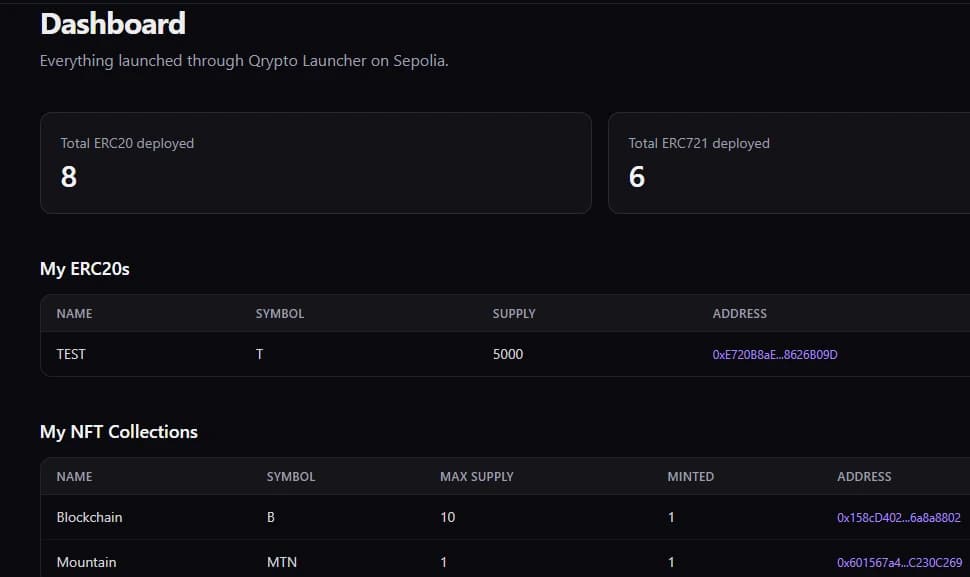
Deploying a contract is only the beginning of managing a blockchain asset. A useful post-deployment experience helps users access important information without searching through blockchain explorers every time — a token dashboard can surface the contract address, deployment status, network information, verification status, token information, and deployment history. QryptoLauncher includes a live deployment dashboard as part of its current feature set, giving users a central place to view information related to their deployments after the initial blockchain transaction has completed.
Which Token Launcher Should You Use?
There is no single token launcher that's ideal for every project — evaluate platforms according to the requirements of your specific deployment. If you need both ERC-20 and ERC-721, look for platforms that support both standards, which matters most if your project needs fungible tokens and NFTs together. If you need Base, check the platform's current Base support directly, since network support can change over time. If you want testnet deployment, choose a platform that supports it so you can test before committing real funds to mainnet. If open-source infrastructure matters to you, check whether the platform publishes its contracts and relevant infrastructure so technically capable users can inspect the implementation. If advanced token controls matter, compare the customization options each platform offers, since some provide significantly more than others. And if cost matters, compare the platform's service fee separately from blockchain gas costs — a low service fee doesn't necessarily mean a lower overall cost in every situation, and network fees change.
QryptoLauncher vs Other Token Launchers: Understanding the Differences
Token launchers are designed around different priorities. Some platforms offer broader token customization, multiple token types, multi-chain deployment, or advanced management features, while QryptoLauncher currently focuses on a more specific workflow: no-code ERC-20 and ERC-721 deployment on Base, with testnet support, verification, open-source contracts, user ownership, and a live dashboard. The important distinction is that different feature sets serve different users, not that one platform is objectively best. On fees, the honest comparison is that the platforms researched for this article use different fee structures — QryptoLauncher's listed service fee was 0.00027 ETH, while other platforms in the comparison listed fees ranging from roughly 0.03 ETH to 0.06 ETH. On features, feature sets vary considerably: some platforms provide advanced token controls and multi-chain functionality, while QryptoLauncher currently focuses on ERC-20 and ERC-721 deployment on Base. On transparency, QryptoLauncher uses open-source contracts and user-owned deployments, allowing users to inspect the contracts and retain ownership through their own wallet, rather than any platform claiming to be simply "the safest." On ease of use, a more defensible description than calling any one platform "the easiest" is that QryptoLauncher provides a no-code interface designed to simplify the configuration and deployment of ERC-20 and ERC-721 contracts — framing it this way makes a token launcher comparison more useful, because readers can evaluate differences according to their own requirements.
The Future of No-Code Web3 Development
No-code development tools are becoming an increasingly important part of the broader Web3 infrastructure ecosystem. The goal isn't necessarily to replace blockchain developers — instead, no-code tools reduce the technical barrier for people who want to interact with blockchain infrastructure without becoming Solidity developers themselves. Future developments in no-code Web3 tooling could include more blockchain networks, more token standards, advanced token customization, better analytics, automated verification, additional wallet integrations, deployment monitoring, DAO and governance integrations, and more sophisticated contract management. As blockchain applications become more diverse, interfaces that simplify deployment may help more users experiment with on-chain infrastructure — while developers remain important for designing, auditing, testing, and maintaining the underlying smart contracts and protocols. No-code Web3 infrastructure doesn't necessarily replace developers; it provides another layer between users and the underlying blockchain technology.
Conclusion: Choosing a Token Launcher Based on Your Requirements
There is no single token launcher that's ideal for every use case. Different platforms prioritize different combinations of token standards, blockchain networks, pricing, customization, testnet support, contract ownership, verification, open-source infrastructure, and post-deployment tools. For someone looking to create an ERC-20 token, the most important factors may be ERC-20 support, network compatibility, pricing, ownership, and verification. For an NFT project, ERC-721 support and the available NFT configuration options may matter more. For developers and technically focused users, open-source contracts and transparent ownership may get more attention. For users deploying on Base, current Base support and testnet availability are key considerations. QryptoLauncher is one approach within this growing category — its current focus is straightforward ERC-20 and ERC-721 deployment on Base, supported by testnet deployment, contract verification, open-source contracts, user ownership, and a live dashboard. The best token deployment platform ultimately depends on what you need to deploy, where you need to deploy it, how much customization you require, and which ownership and transparency characteristics matter to your project.
Frequently Asked Questions
What is a no-code token launcher?
A platform that provides an interface for configuring and deploying blockchain token contracts without requiring users to write the smart contract themselves. The typical workflow involves configuring the token, connecting a wallet, selecting a network, approving a transaction, and accessing the resulting deployment.
Can I create an ERC-20 token without coding?
Yes. No-code token deployment platforms provide interfaces for configuring and deploying ERC-20 contracts without manually writing Solidity. The exact configuration options depend on the platform.
Can I create an ERC-721 NFT contract without coding?
Yes, where the token launcher supports ERC-721. Users configure the available NFT contract parameters through the platform's interface and then deploy through a connected Web3 wallet.
How much does it cost to deploy an ERC-20 token?
The total cost can include both a token launcher's service fee and the blockchain's gas fee. In the research used for this comparison, QryptoLauncher's listed service fee was approximately 0.00027 ETH (around $0.50); other platforms listed different fees. Because prices and network costs change, verify current fees before deployment.
Can I deploy a token on Base without writing Solidity?
Yes, if the token launcher supports Base and provides a no-code deployment workflow. QryptoLauncher currently supports ERC-20 and ERC-721 deployment on Base.
What is the difference between a token launcher fee and gas fees?
A token launcher fee is charged by the platform for its deployment service. A gas fee is paid to the blockchain network for processing the transaction. They are separate costs.
Can I test my token on a testnet before mainnet deployment?
Some token launchers support testnet deployment, which is useful for learning, testing contract behavior, and checking deployment workflows before using real funds on mainnet.
Who owns a token deployed through a token launcher?
Ownership depends on the smart contract implementation. Verify which wallet controls the deployed contract, whether ownership can be transferred, and whether the platform retains any administrative control. QryptoLauncher currently uses user-owned deployed contracts.
Why is smart contract verification important?
Verification makes the contract source code available through supported blockchain explorers, which improves transparency and makes it easier for users and developers to inspect the deployed contract. Verification should not, by itself, be interpreted as a security audit.
Are no-code token launchers safe?
A no-code interface can simplify deployment, but the interface itself doesn't guarantee that a token contract is secure. Examine the contract implementation, ownership model, verification status, and permissions before deploying a production asset.
What should I compare before choosing a token launcher?
ERC-20 support, ERC-721 support, blockchain networks, Base support, testnet support, service fees, gas costs, contract ownership, verification, open-source availability, customization, and post-deployment tools.
Does QryptoLauncher support ERC-20 and ERC-721?
Yes. QryptoLauncher currently supports both ERC-20 and ERC-721 deployment, including deployment on Base and supported testnet environments.